
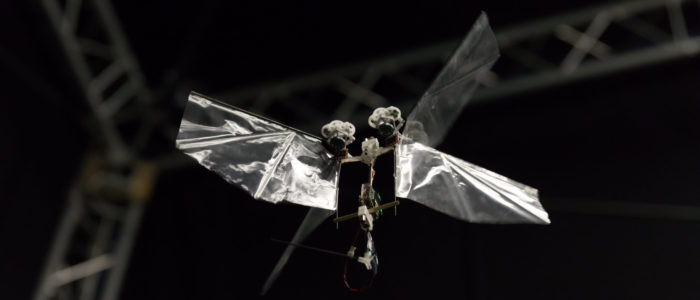
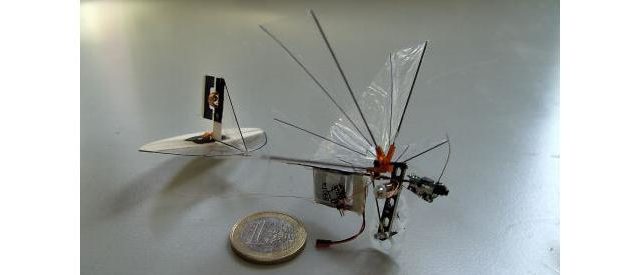
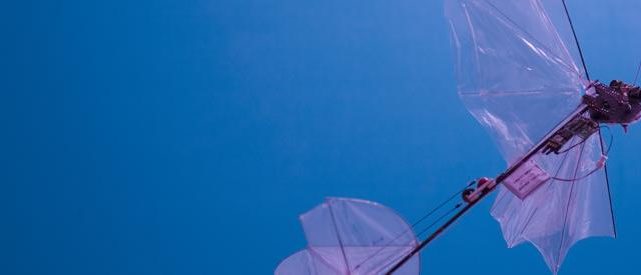
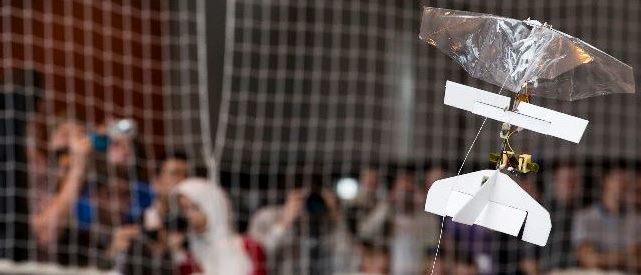
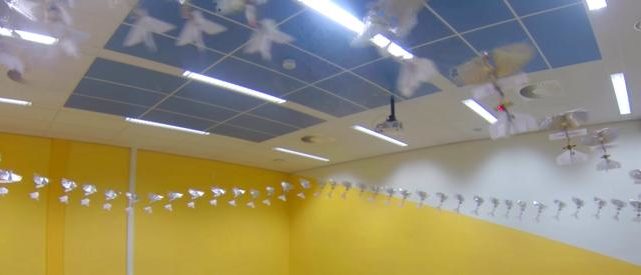
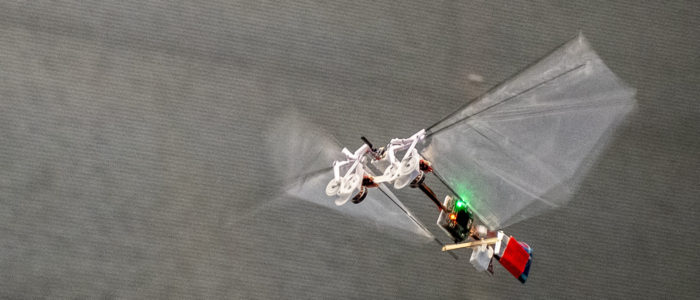
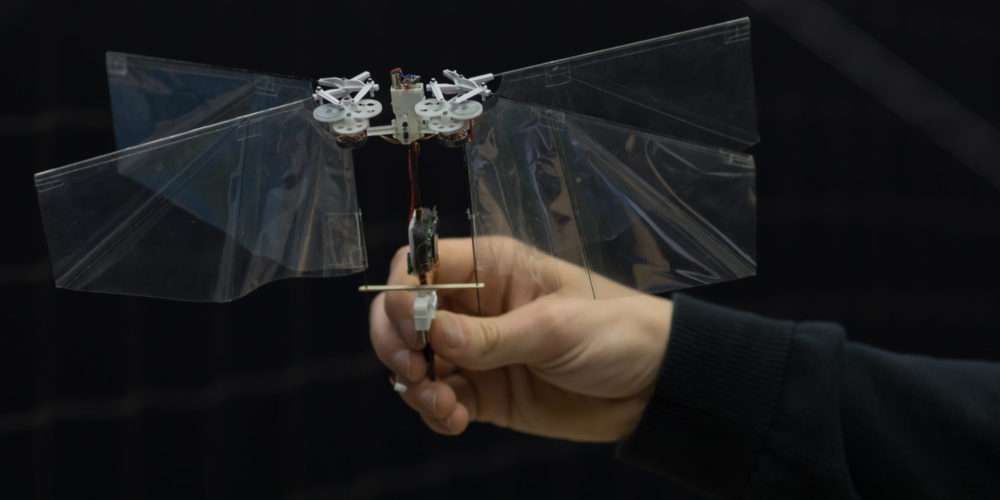
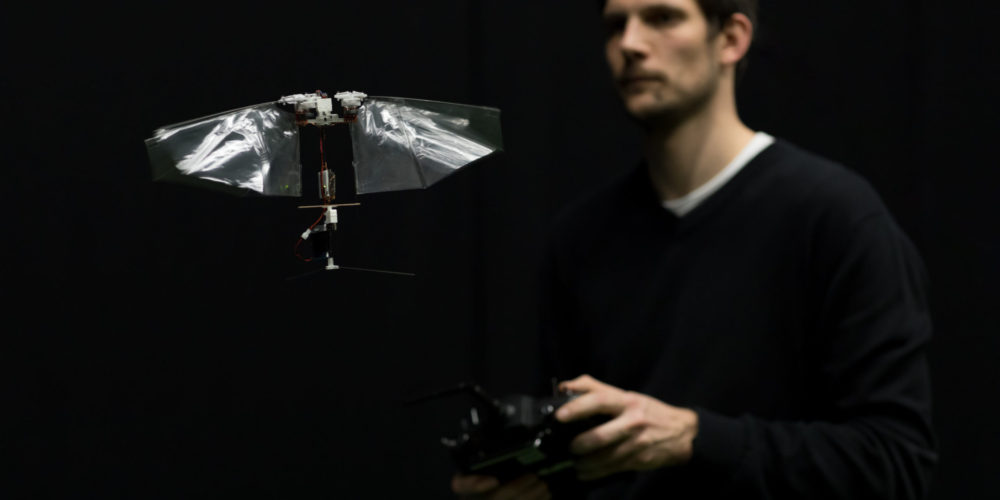
DelFly Nimble is our newest and most agile design which can hover or fly in any direction (up, down, forward, backward or sideways). Unlike its predecessors, which are controlled like a conventional airplane via deflections of control surfaces located on the tail or behind the wings, the DelFly Nimble has no tail nor such control surfaces. Instead, it is controlled through insect-inspired adjustments of motion of its two pairs of flapping wings. The lack of the tail makes the DelFly Nimble less vulnerable to damage and highly agile, allowing also outdoors operation in light winds.
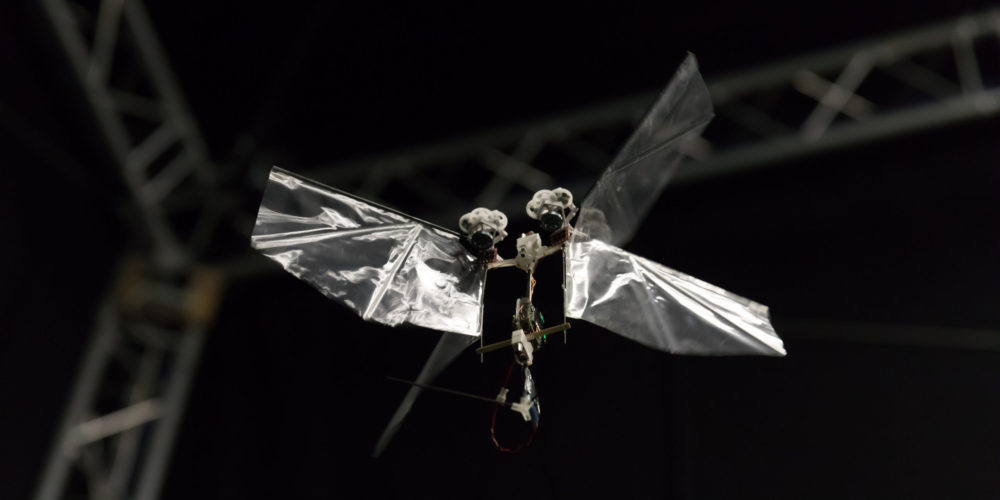 DelFly Nimble in hover
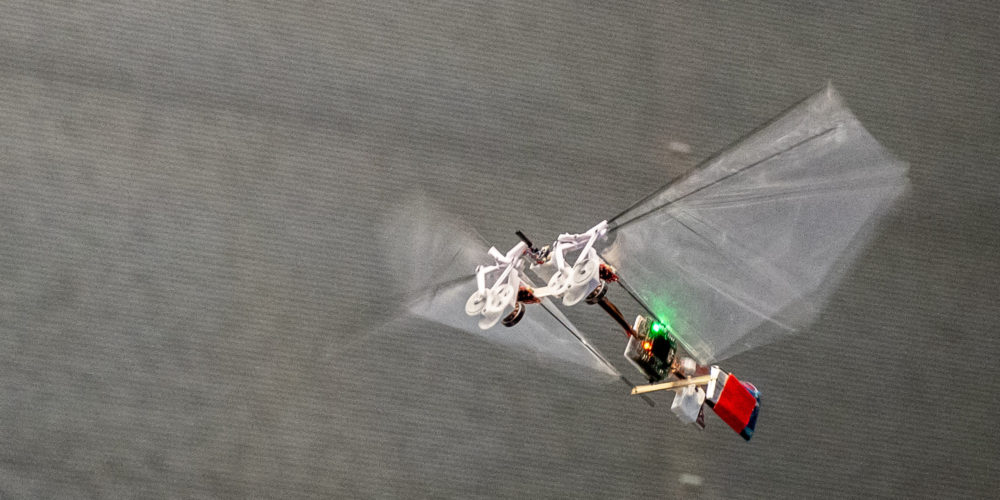
Exceptional performance
At hover, the 29-g and 33-cm wingspan robot can fly for more than 5 minutes on a fully charged battery, while its 14 cm wings flap at a frequency of approx. 17 Hz. Its outstanding power efficiency peaks at a forward cruise speed of approx. 3 m/s (~11 km/h) and enables a flight range of more than 1 kilometer. This is thanks to design optimizations carried out with its tailed predecessor, the DelFly II, from which the flapping mechanism and wings were inherited. The robot has a thrust-to-weight ratio of more than 1.3 and is capable of carrying an additional payload of up to 4 grams (e.g. a camera system with a live video feed, additional sensors, etc.). The exceptional agility can be demonstrated by 360-degree flips around the pitch or roll axes or rapid transitions from hover to forward or sideways flight, and vice versa. At full throttle, the robot reaches a top speed of 7 m/s (~25 km/h).
Bio-inspired wing-based control
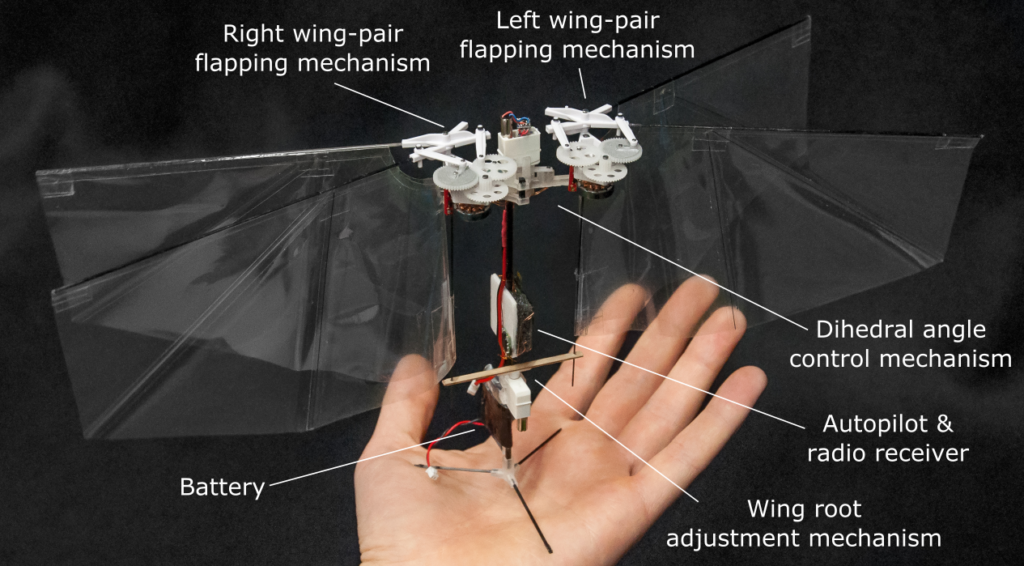
Like in quadrotors or helicopters, but also like in insects, forward/backward and sideways flight is achieved by pitching and rolling the robot’s body into the respective direction. To control the body orientation (attitude), the robot needs to be able to produce torques around the three orthogonal body axes. To this end, the robot is equipped with two, independent, flapping mechanisms, one for each wing pair on the sides of the robot. These are complemented with two rotary servo actuators, one adjusting the dihedral angle by changing the relative orientation of the two flapping mechanisms, and the other actuating the tips of the left and right wing-pair roots. Rolling is achieved by driving the two wing pairs at different flapping frequencies, which results in a thrust difference creating the torque around the roll axis. Pitch torque is produced by adjusting the dihedral angle (central line of the flapping wings), which shifts the wingbeat-average thrust vectors of the two wing pairs forward or backward, with respect to the center of mass. Finally, yawing is achieved by actuating the roots of the left and right wing pairs such that their respective wingbeat-average thrust forces are tilted in opposite directions, creating torque around the yaw axis. Due to the lack of a tail, which provided passive stability in the previous designs, the robot relies on active stabilization, enabled by the onboard autopilot (STM32 microcontroller, MPU6000 6DOF IMU) and Paparazzi UAV software.
New applications
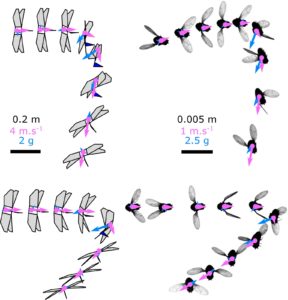
The so far unmatched combination of performances makes the lightweight (and thus inherently safe) natural-looking robot ready for many real-world tasks. At the same time, the high agility, combined with the programmability of the robot, opens up a new way of studying insect flight dynamics and control during high agility maneuvers, such as rapid banked turns observed in fruit-flies when evading predators.
Related publications
Matěj Karásek, Florian T. Muijres, Christophe De Wagter, Bart D.W. Remes, Guido C.H.E. de Croon: A tailless aerial robotic flapper reveals that flies use torque coupling in rapid banked turns. Science, Vol 361, Iss 6407, 2018. DOI: 10.1126/science.aat0350. Full text, pdf reprint.
For media
A set of high-resolution photos and raw videos of the DelFly Nimble, released under the CC BY-SA 4.0 license, can be downloaded here: photos, videos. For other requests, please contact M.Karasek@tudelft.nl.